
Perfumer vs Stock Scents: Quality Control Checkpoints That Matter
Quality control is the same job on both routes — confirming that what ships matches what was approved — but the checkpoints sit in different places. A bespoke development puts the control points inside your own project: brief, rounds, retained reference, bulk batch. A stock scent moves the control to trust in the stock owner's system, and your checkpoints compress into receiving and inspection. For a gift and travel set, where small formats multiply risk, mapping those checkpoints in advance is the difference between a routine launch and a recall. This article walks the map.
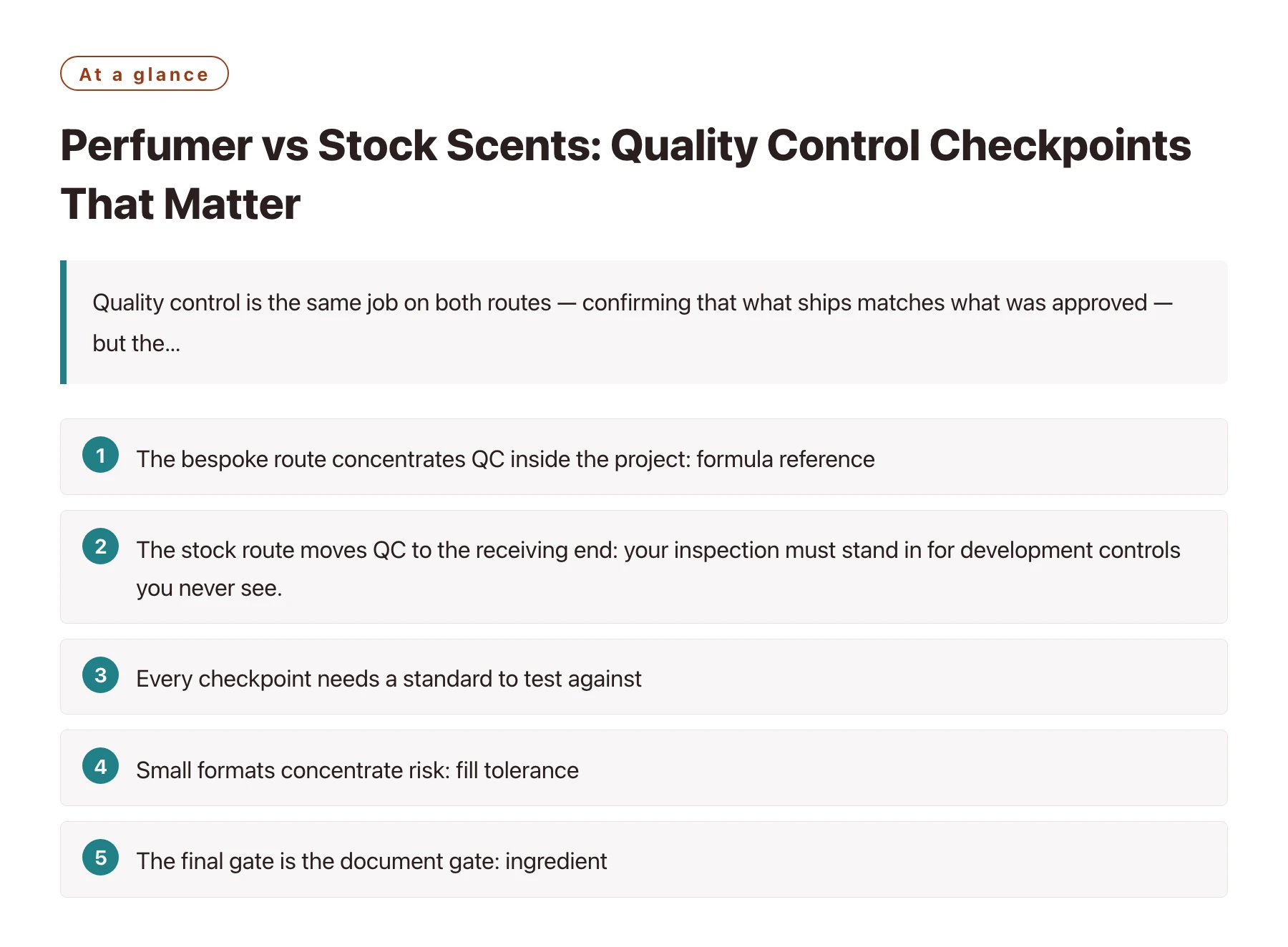
Key takeaways
- The bespoke route concentrates QC inside the project: formula reference, retained sample and batch record are the three anchors.
- The stock route moves QC to the receiving end: your inspection must stand in for development controls you never see.
- Every checkpoint needs a standard to test against; without a written pass criterion, a checkpoint is a meeting, not a control [1].
- Small formats concentrate risk: fill tolerance, evaporation and decoration on travel sizes deserve their own checkpoints [2].
- The final gate is the document gate: ingredient, allergen and claim files have to match the product before it ships, not after.
A quality control checkpoint is a moment where the product is compared against a written standard and the result is recorded. Absent that definition, most 'quality checks' in small brands are hope with a clipboard.
Whether the scent comes from a bespoke perfumer or a stock library changes where those moments sit. This article maps both routes so the checkpoints can be named before the first order, not invented after the first complaint.
Six checkpoints from brief to bulk
- Brief gateThe written brief is complete and the factory confirms it can hit concentration, format and market constraints.
- Formula gateThe formula is fixed, registered under a reference, and its restriction data is checked against the category [2].
- Reference gateThe retained sample is sealed, dated, batch-numbered and signed by both parties at the agreed stage.
- First-run gateA pilot at the final format is weighed, inspected and compared against the retained reference.
- Bulk gateThe production batch is checked against the reference with recorded results; failures stop the release.
- Document gateIngredient, allergen and market files match the shipped product, variant by variant.
Where the checkpoints sit on each route
| Checkpoint | Bespoke route | Stock route |
|---|---|---|
| Brief and constraints | Brand writes it; factory confirms | Usually fixed by the stock code |
| Formula control | Brand holds the reference and data | Formula owner holds them; brand receives a pack |
| Retained reference | Sealed sample from the approved batch | Reference is the stock code's master sample |
| First run | Pilot at final format with recorded checks | First delivery is inspected harder than later ones |
| Bulk batch | Release after comparison to reference | Certificate of analysis plus receiving inspection |
| Market documents | Built from the brand's own file | Dependent on the stock owner's data scope |
Read the two columns as different risk distributions. The bespoke route risks the middle of the process; the stock route risks both ends — the data you never see and the units you receive.
Running the checkpoints without theatre
A checkpoint is only as good as its standard. 'Check the smell' is not a standard; 'compare against the retained reference under the same test protocol' is. The same logic applies to fill weight, evaporation, decoration and documents: each needs a measurable criterion and a recorded result, which is exactly the discipline that cosmetics GMP frameworks are designed to make routine [1].
On the bespoke route the brand buys that discipline as part of the development service, which is why asking to see a batch record from a partner's last run is more informative than asking for its certificate wall. On the stock route the brand cannot see the process, so the receiving inspection carries the load: weigh units, check closures, inspect decoration, and compare the batch against the stock reference.
Manufacturers that keep compounding, filling and inspection under one roof make this easier to verify, because the record and the process live in one place: a fragrance manufacturing under one roof operation can show the full chain from raw material intake to packed unit without stitching together partner files.
Small formats deserve their own gates
A travel or gift set is several small products in one box, and each one concentrates the same risks into less material. Fill tolerance that passes on a 50 ml bottle is visible on a 5 ml vial; evaporation that nobody notices in a large bottle empties a mini; decoration defects sit side by side in the same sleeve. The practical rule is to run the first-run gate at set level: fill, closes, decorate and box on the actual units the customer will receive.
The route choice does not change this rule; it changes who owns the data. Whether the scent is bespoke from Xuelei or a stock code bought from a library, the set-level checks are the same, and the brand that specifies them in the purchase order gets what it specified.
The cheapest checkpoint is the one that runs before the expensive material is committed. Naming all six gates before the first order — then refusing to skip the first-run gate — keeps the excitement inside the schedule where it belongs.
The document gate closes the loop
The last checkpoint is not physical. The ingredient list, allergen information, claim support and market notification all have to match the product that actually shipped, variant by variant. EU rules on cosmetic product claims and specific topics are a usable reference for what must be documented before claims go on the label [3].
Because this gate is the one where bespoke and stock truly split, buyers often settle it by checking the manufacturer's published scope and data practices first. A quick look at www.xuelei.com shows how much of the service scope a manufacturer publishes openly, which is a reasonable proxy for how its documentation behaves — not a guarantee, but a strong prior.
Sources
- SGS: Cosmetics, Personal Care & Household Testing —— Testing, inspection and certification services for cosmetics and personal care, including microbiological, stability and safety testing aligned with cosmetics GMP.
- IFRA: Safe Use and Fragrance Science —— IFRA's explanation of how fragrance materials are scientifically assessed for safe use and how those conclusions are applied by the industry.
- European Commission: Cosmetic Products — Specific Topics —— EU pages covering specific cosmetics topics such as product claims, nanomaterials and animal-testing rules.
Frequently asked questions
What is a quality control checkpoint?
A moment where the product is compared against a written standard and the result is recorded. Without a measurable criterion and a record, a checkpoint is just a meeting.
How does QC differ between bespoke and stock scents?
Bespoke puts the control points inside the project, where the brand holds the reference and batch records. Stock moves the control to receiving and inspection, because the development process belongs to the stock owner.
Why do travel sets need stricter checkpoints?
Small formats concentrate risk: less fill, more evaporation exposure, tighter decoration tolerance, and several units sharing one box. A defect that is invisible on a large bottle is visible in a set.
What should the first-run gate check on a gift set?
Fill weight within tolerance, closure integrity, decoration matched to the approved reference, and box assembly — on the actual production units, against a written record.
Can a stock scent be quality-controlled properly?
Yes, with a heavier receiving inspection and a certificate of analysis: weigh, inspect, retain, and compare against the stock reference each delivery. The checks are possible; they just sit at your end of the chain.